
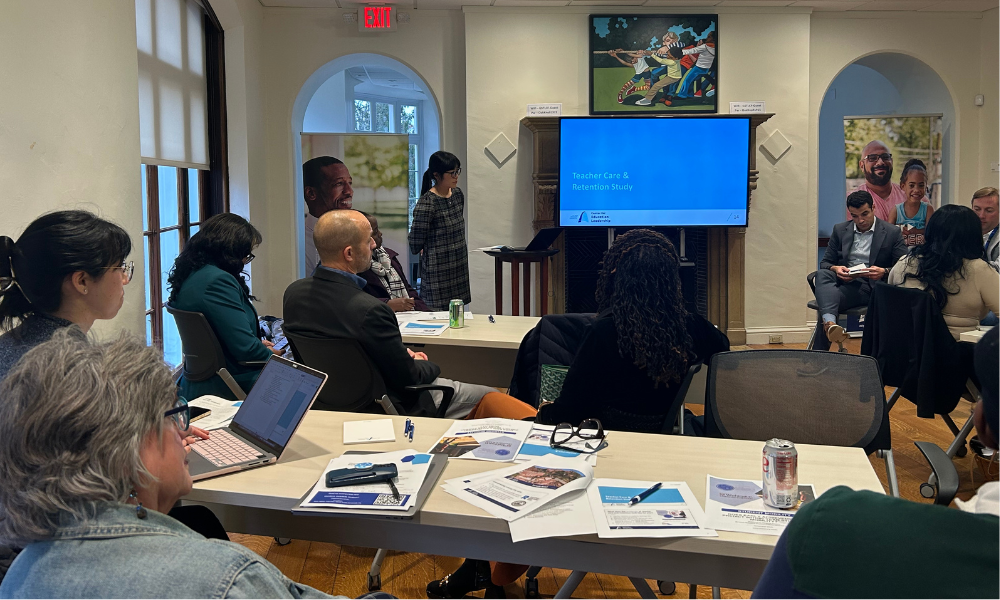
Great teachers are the heart of our schools, and ensuring they feel supported is key to student success across St. Louis. Through the SRPC, we are working in close partnership with local districts to explore how to improve teacher care and retention, creating school environments where both educators and students thrive. A new educator brief developed by Mary M. Smith, Ph.D. for the SRPC, explores the persistent challenge of teacher care and retention, and explore strategies for improving the trends.
Highlights from the Teacher Care & Retention Brief
Understanding the Teacher Retention & Care Challenge
Teacher retention rates are slowly improving nationwide[1]. but the challenge remains particularly acute in the St. Louis area.[4]. High turnover rates often impact school culture and student achievement and researchers have documented a negative impact of teacher shortages on schools.
What the Data Tells Us So Far
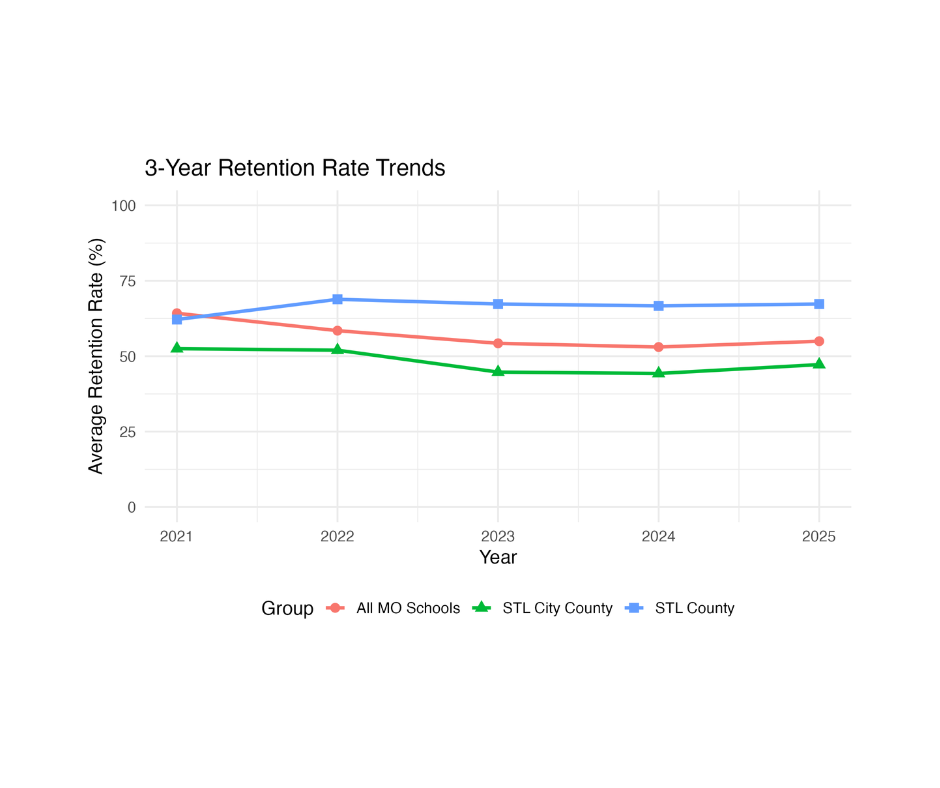
The SRPC is analyzing administrative data to better understand these trends. The charts below show that while St. Louis County schools retain teachers at a higher rate, St. Louis City schools lag behind both the county and the state average. These averages also mask considerable variation between schools, presenting an opportunity to explore what’s working and where we can provide more support.
Year-to-Year Teacher Retention
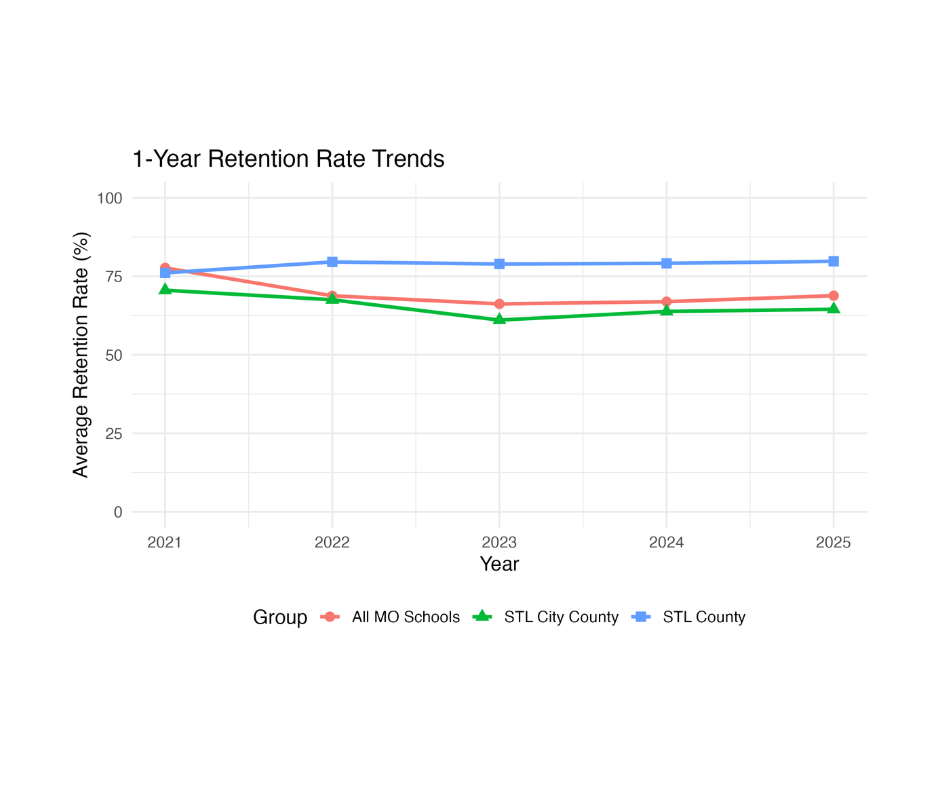
Graphs Developed by Megumi Hine, PhD.
Three-Year Teacher Retention
Evidence-Based Strategies for Stronger Schools
Research shows that the most effective efforts to improve teacher care and retention combine different types of targeted supports tailored to a teacher’s career stage and school environment. There is no one-size-fits-all solution, but by investigating the data and listening to what practitioners are doing across the region, districts can make informed decisions for what approach is right for their district. Here are a few promising approaches.
Improving how teachers are recruited to the profession broadly and to a district or school specifically can increase retention and ensure that teachers feel prepared, confident, and supported at their school. District policies for hiring and recruiting teachers can either help or hinder schools in selecting teachers who are a good fit. Granting schools greater autonomy in hiring decisions and streamlining HR processes can allow schools to attract and hire candidates who are right for the school. However, clear norms and policies for screening applicants including using standardized interviews and rubrics are critical for reducing the impact of implicit biases and ensuring the hiring process is fair.
Spotlight Strategy: Open Hiring and Mutual Consent Policies
How it works: Under an open hiring or mutual consent model, schools are allowed to hire any candidate they deem qualified with no required preference for internal candidates. In this process, school hiring teams extend a hiring offer that a candidate must agree to. This process differs from one in which internal or tenured candidates are given required preference in hiring and/or where “excessed” teachers are automatically placed in open positions across the district.
What the research says: A study of open hiring policies in Boston found increases in the racial diversity of hired teachers, improved retention for early-career teachers, and higher student achievement [6]. Similar open hiring and mutual consent policies in New York City are associated with higher rates of job satisfaction [7].
Spotlight Strategy: Protected Planning Time
How it works: In Missouri, full-time teachers are required to have a minimum of 250 minutes of planning time a week [9]. However, these planning blocks can be interrupted for other tasks or distractions (e.g. assisting with classroom supervision) leaving teachers with insufficient or low-quality time to get planning done. Schools and districts can adopt strategies that ensure all teachers have an adequate amount of uninterrupted planning time each day or week.
What the research says: Teachers who report having adequate planning time have higher job satisfaction and are less likely to leave their job [10].
While resources are scarce in public education, evidence shows that improving teacher compensation is effective for retaining teachers. Strategies that improve compensation, particularly when coupled with other interventions, can be effective at attracting and retaining teachers.
Spotlight Strategy: Salary Increases
How it works: Salary increases can be implemented in a variety of ways such as across-the-board uniform increases in pay or pay increases that are differentiated based on teacher performance, experience, and training.
What the research says: Larger pay increases are strongly linked to higher teacher retention and lower intentions to leave. Nationally representative survey data from 2024 shows that teachers who received bigger raises were more likely to report that their pay was adequate and less likely to plan to exit the profession [11].
Intentional professional development and clear career pathways encourage teachers to feel supported by their district and school. These initiatives not only enhance morale and job satisfaction but also contribute to the continuous growth of teachers’ skills and competencies. Providing structured opportunities for learning, advancement, and recognition enables districts to build a more resilient and effective teaching workforce that is better equipped to meet diverse student needs and adapt to evolving educational demands.
Spotlight Strategy: Mentoring
How it works: Mentoring pairs experienced teachers with newer educators to provide guidance, support, and professional growth opportunities. The goal of mentoring relationships is to foster skill development, confidence, and a sense of belonging for teachers within the school community.
What the research says: Mentoring programs significantly improve new teacher retention by providing emotional support, instructional guidance, and professional socialization. Not only have mentoring programs been linked to increased retention rates among new teachers, mentoring and new teacher induction programs can improve teacher effectiveness leading to increases in student academic performance [12]. Successful mentoring programs are typically characterized by: connecting mentees to mentors in the same subject and allowing for regularly scheduled, frequent meeting between mentees and mentors [13].
- 1] Diliberti, Melissa Kay and Heather L. Schwartz, Educator Turnover Continues Decline Toward Prepandemic Levels: Findings from the American School District Panel. Santa Monica, CA: RAND Corporation, 2025. https://www.rand.org/pubs/research_reports/RRA956-29.html; Tan, T. S., Comai, S., & Patrick, S. K. (2025). State teacher shortages 2025 update: Teaching positions left vacant or filled by teachers without full certification. Learning Policy Institute. https://learningpolicyinstitute.org/product/state-teacher-shortages-vacancy-resource-tool-2025
- [2] Amitai & Van Houtte, 2022
- [3] Ronfeldt et al., 2013; Sorenson & Ladd, 2020
- [4] Missouri Department of Elementary and Secondary Education, 2023
- [5] https://dese.mo.gov/educator-preparation-first-year-educator-survey-information
- [6] Kraft, M. A., Papay, J. P., Wedenoja, L., & Jones, N. (2020). The Benefits of Early and Unconstrained Hiring: Evidence from Teacher Labor Markets.”. Edworkingpapers. Annenberg Institute at Brown University.
- [7] Daly, T., Keeling, D., Grainger, R., & Grundies, A. (2008). Mutual Benefits: New York City’s Shift to Mutual Consent in Teacher Hiring. Updated with a New Afterword. New Teacher Project.
- [8] Perrone, F. (2022). Leadership and Teacher Retention. Routledge. https://doi.org/10.4324/9781138609877-REE85-1
- [9] https://dese.mo.gov/communications/frequently-asked-questions-and-educational-topics#:~:text=Planning%20Time%E2%80%94Each%20full%2Dtime,%2C%20counselors%2C%20or%20librarians.)
- [10] Bettini, E., Cumming, M. M., O’Brien, K. M., Brunsting, N. C., Ragunathan, M., Sutton, R., & Chopra, A. (2019). Predicting Special Educators’ Intent to Continue Teaching Students with Emotional or Behavioral Disorders in Self-Contained Settings. Exceptional Children, 86(2), 209-228. https://doi.org/10.1177/0014402919873556 (Original work published 2020)
- [11] Steiner, E. D., Woo, A., & Doan, S. (2024). Larger Pay Increases and Adequate Benefits Could Improve Teacher Retention: Findings from the 2024 State of the American Teacher Survey. American Educator Panels. Research Report. RR-A1108-13. RAND Corporation. https://www.rand.org/pubs/research_reports/RRA1108-13.html
- [12] Ingersoll, R. M., & Strong, M. (2011). The impact of induction and mentoring programs for beginning teachers: A critical review of the research. Review of educational research, 81(2), 201-233.
- [13] Callahan, J. (2016). Encouraging retention of new teachers through mentoring strategies. Delta Kappa Gamma Bulletin, 83(1), 6.; Maready, B., Cheng, Q., & Bunch, D. (2021). Exploring mentoring practices contributing to new teacher retention: An analysis of the beginning teacher longitudinal study. International Journal of Evidence Based Coaching & Mentoring, 19(2).